Monday, July 2, 2012

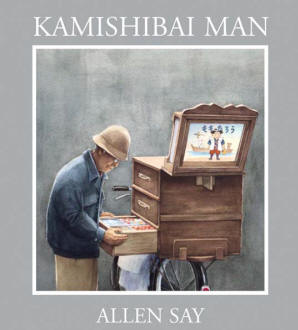
Kamishibai Man

 Kamishibai Man written and illustrated by Caldacott Award winner Allen Say is a beautifully drawn and told tale of a time when these special men plied their trade on the streets of Japan.                                                    Kamishibai pronounced kah-MEE-shee-bye, means "paper drama" in Japanese. Kamishibai was a popular form of street storytelling in Japan during the late 1920's until the early 1950's. The Kamishibai man was primarily a candy seller. He used storytelling to entice the children to his "store". He then entertained them with his stories. Kamishibai uses illustrated story cards that are slid into a wooden frame which serves as the "stage".  The Kamishibai man frequently told the stories in serial form leaving his patrons with a cliffhanger ending which encouraged them to come see him the next time he came to their area.
Allen Say's Kamishibai Man is his way of remembering the kamishibai men of his childhood. A review of this book at Kamishibai.com says:
"The Kamishibai Man of this story is called simply Jiichan, meaning Grandpa: he belongs to all children who will listen to his stories. His wife is Baachan, Grandma; and she too has an important role, albeit behind the scenes: she makes the sweets that Jiichan hands out to his audience. As the book unfolds, the story shifts almost imperceptibly from the present to the past and his reminiscences of kamishibai themselves become the theater's storyboards. He takes us, his readers, with him as his audience and lulls us with these reminiscences - until we are jolted back into the present by the shouts from the audience in the story-an audience not of children but of adults reglimpsing their lost childhood."   Marjorie Coughlan, June 2006 PaperTigers Reader  www.papertigers.org


To learn more about Kamishibai, you can take a look at storyteller Diane De Las Casas' book Kamishibai Story Theater: The Art of Picture Telling

the following websites can also help you with the history and application of kamishibai:


http://www.primaryteachers.org/japan_books.htm - this teacher site features a number of Japanese tales in picture book form as well as information on kamishibai

 The following videos are very helpful in telling what Kamishibai is and in showing it used.


Story extension activity:
Have the children create their own Kamishibai story cards. They can draw pictures on regular paper and then glue them to the front of a piece of cardboard or card stock. You can then write the story action on the back of the cards. 


Wednesday, June 27, 2012

Only 3 Hours Left! Combining Storytelling and Crafts!

Hand Knit and Crocheted "anything" Finger Puppets

 I call these "Anything" puppets because they are not made to represent any specific animal or person. They are "anything" you imagine them to be.
These are available as a reward on my Kickstarter Project.
I will have directions on how to make them soon!

Thursday, June 14, 2012

This Old Man aka Knick-Knack Paddy Whack

"This old man he played one. He played knick knack on my thumb. With a knick knack paddy whack, give a dog a bone, this old man came rolling home!"

This Old Man is a very popular nursery rhyme.
It's fun to sing or chant, focuses on rhyming and counting and has been used as the basis for many picture books.

Below is the video version of the book Knick Knack Paddy Whack by Christiane Engel.


Knick-Knack Paddy Whack aka This Old Man Activities:

Make a Song Rebus for This Old Man. Check this one at Enchanted Learning

 Rhyming Words: Point out the rhyming words in the song. Notice the difference in the rhymes used in the traditional version of the song and the rhymes used in the video version. Have the children make up their own number rhymes.

Expand the Rhyme: Make up rhymes up to the number 20 and beyond.

Make up a Story and Act it out: Why is the Old Man playing one...etc? What happens when he is finished?

Read a Different version of the song: Get a copy of  This Jazz Man by Karen Ehrhardt. Ehrhardt's "old man" really swings the song. Here's an example:
"This jazz man, he plays one,
He plays rhythm with his thumb,
With a snap! snap! snazzy-snap!
Give the man a hand,
This jazz man scats with the band."
The lyrics below are just one version of This Old Man:

This old man, he played one
He played knick-knack on my thumb
With a knick-knack patty-whack, give a dog a bone
This old man came rolling home

This old man, he played two
He played knick-knack on my shoe
With a knick-knack patty-whack, give a dog a bone
This old man came rolling home

This old man, he played three
He played knick-knack on my knee
With a knick-knack patty-whack, give a dog a bone
This old man came rolling home

This old man, he played four
He played knick-knack on my door
With a knick-knack patty-whack, give a dog a bone
This old man came rolling home

This old man, he played five
He played knick-knack on my hive
With a knick-knack patty-whack, give a dog a bone
This old man came rolling home

This old man, he played six
He played knick-knack on my sticks
With a knick-knack patty-whack, give a dog a bone
This old man came rolling home

This old man, he played seven
He played knick-knack up in heaven
With a knick-knack patty-whack, give a dog a bone
This old man came rolling home

This old man, he played eight
He played knick-knack on my gate
With a knick-knack patty-whack, give a dog a bone
This old man came rolling home

This old man, he played nine
He played knick-knack on my spine
With a knick-knack patty-whack, give a dog a bone
This old man came rolling home

This old man, he played ten
He played knick-knack once again
With a knick-knack patty-whack, give a dog a bone
This old man came rolling home


Tuesday, May 8, 2012

A Storytelling Chair

 Hmm... maybe that should be, a chair for storytelling?

I saw this chair while cruising the net (hit the wrong keys and there it was) and thought it was really cute. I just wish it looked a little more comfortable but I do love the idea.


Saturday, December 31, 2011

Cute New Years Songs to Sing with Kids!


Happy 2012!! Here are a few simple songs to sing welcoming the new year....


New Year's Day


(Sung to the tune of "Jingle Bells")
New Year's Day, New Year's Day

Comes but once a year.

On New Year's Eve we celebrate

And ring it in with cheer!


New Year's Day, New Year's Day

Comes but once a year.

On New Year's Eve we celebrate

And ring it in with cheer!

Author Unknown


Happy New Year

(Sung to the tune of "Are You Sleeping?")
Happy New Year!

Happy New Year!

2012!
2012!

Good-bye to the old year!

Hello to the new year!

2012!
2012!
Author Unknown


A New Year Has Begun

(Sung to the tune of "She'll be Coming 'Round the Mountain")
There's a new year on our calendar today…

(Shout) 2012!

There's a new year on our calendar today…

(Shout) 2012!

There's a new year on our calendar,

A year to grow and learn much more.

There's a new year on our calendar today--

(Shout) 2012!

Author Unknown


Brand New Year

(Sung to the tune of "Do You Know the Muffin Man?")

Now we have a brand new year,

A brand new year, a brand new year.

Now we have a brand new year.

2012's begun.

Author Unknown


Saturday, May 28, 2011

The Little Yellow Tulip.....story and activities

THE LITTLE YELLOW TULIP

Once there was a little yellow Tulip, and she lived down in a little dark house under the ground. One day she was sitting there, all by herself, and it was very still. Suddenly, she heard a little tap, tap, tap, at the door.

"Who is that?" she said.

"It's the Rain, and I want to come in," said a soft, sad, little voice.

"No, you can't come in," the little Tulip said.

By and by she heard another little tap, tap, tap on the window-pane.

"Who is there?" she said.

The same soft little voice answered, "It's the Rain, and I want to come in!"

"No, you can't come in," said the little Tulip.

Then it was very still for a long time. At last, there came a little rustling, whispering sound, all round the window: rustle, whisper, whisper.

"Who is there?" said the little Tulip.

"It's the Sunshine," said a little, soft, cheery voice, "and I want to come in!"

"N—no," said the little Tulip, "you can't come in." And she sat still again.

Pretty soon she heard the sweet little rustling noise at the keyhole.

"Who is there?" she said.

"It's the Sunshine," said the cheery little voice, "and I want to come in, I want to come in!"

"No, no," said the little Tulip, "you cannot come in."

By and by, as she sat so still, she heard tap, tap, tap, and rustle, whisper, rustle, up and down the window-pane, and on the door and at the keyhole.

"Who is there?" she said.

"It's the Rain and the Sun, the Rain and the Sun," said two little voices, together, "and we want to come in! We want to come in! We want to come in!"

"Dear, dear!" said the little Tulip, "if there are two of you, I s'pose I shall have to let you in."

So she opened the door a little wee crack, and in they came. And one took one of her little hands, and the other took her other little hand, and they ran, ran, ran with her right up to the top of the ground. Then they said,—

"Poke your head through!"

So she poked her head through; and she was in the midst of a beautiful garden. It was early springtime, and few other flowers were to be seen; but she had the birds to sing to her and the sun to shine upon her pretty yellow head. She was so pleased, too, when the children exclaimed with pleasure that now they knew that the beautiful spring had come!

from Stories to Tell Children,Fifty-Four Stories With Some Suggestions For Telling by Sara Cone Bryant


Make a simple Tulip life-cycle book

Make Tulip. Stick Puppets...all you need are sticks_you can gather some from outside or use craft sticks; paper to make the flowers and leaves; glue; markers or crayons and pictures of tulips that the kids can use for inspiration

Act out the story...
Have .children play the parts of the Yellow Tulip, the Rain and the Sun. You could also stretch the play to include children admiring the flower as it blooms.

Sunday, March 6, 2011

World Read Aloud Day.....March 9, 2011


Wednesday, March 9, 2011 is World Read Aloud Day.
WRAD was started by LitWorld.
LitWorld is an international non-profit organization, whose goal is to
"...cultivate literacy leaders worldwide through transformational literacy experiences that build connection, understanding, resilience and strength. We work with teachers, parents, community members, and children to support the development of literacy and the redemptive power of story in the world's most vulnerable communities."
All over the U.S. there are groups and individuals planning reading activities.  LitWorld is even hosting a 24-Hour Read-Aloud Marathon all day on March 9 in Times Square. Check your area to see if there are any activities planned or plan youe own World Read Aloud Day celebration.

Check out some of my previous blogs for book ideas and activities.

LitWorld's Reading Decree (this statement is found on LitWorld's Blog to be used by anyone hosting a WRAD event)


Today is World Read Aloud Day.
We are uniting our voices in cities and communities across the globe.
We celebrate the power of stories and words to change worlds.
We join our voices for quality literacy education for every child worldwide.
Today 774 million people cannot read or write. They are denied the joy and light of reading every day.
Education is a human right and a means to attaining other human rights that we declare to be universal.
Literacy education improves the health of children and families, spurs economic growth and advances equality.
For many children worldwide, quality education is the difference between life and death, between hope and despair and being able to make the most of one’s potential. This is our opportunity to give voice to the future.
By coming together and raising our voices on this day, we show the world’s children that we support their lives: that they have the right to read, to write and to share their stories to change the world.
Today I pledge my passion for quality education and my support for the cause of literacy. I encourage everyone to take part in this day and this cause.        As a representative of my community, I will continue to advocate for the causes most important to us and I encourage all of you to join me in the fight for our children and all children’s futures.
In observance of World Read Aloud Day, I invite you to take a moment to think about what you would miss most if you could not read or write.
It’s time for all of us to join the global literacy movement. Through our voices we can be free and be part of words changing worlds.

Sunday, February 13, 2011

Whoa Mule!!!

A fun and easy traditional call and response song..... done by Lomax the Hound of Music


Lyrics to Lomax's version of 
Whoa Mule! (Can’t Get the Saddle On!)


Whoa mule!

KIDS: Can’t get the saddle on!

Whoa mule!

KIDS: Can’t get the saddle on!

Catch that mule!

KIDS: Can’t get the saddle on!

Catch that mule!

KIDS: Can’t get the saddle on!

Ride that mule!

KIDS: Can’t get the saddle on!

Ride that mule!

KIDS: Can’t get the saddle on!

Run mule!

KIDS: Can’t get the saddle on!

Run mule!

KIDS: Can’t get the saddle on!

Monday, September 6, 2010

Musical Monday..... I'm Proud to be Me!


This is a song/poem that I learned while working at a summer camp in Alaska.
I researched it and as far as I can tell the song to be of unknown origins.
It's a great song for kids about diversity and tolerance.
I wish I could sing it for you but it would work as a sort of up tempo chant. Experiment with it.


I"m Proud to be Me

I'm proud to be me but I also see
You're just as proud to be you.
We might look at things a bit differently
But lots of good people do.

That's just human nature
So why should I hate you
For being as human as I?

We get what we give.
If we live and let live
We'll both get along if we try.

I'm proud to be me, and I also see
You're just as proud to be you.

It's true!

You're just as proud to be you!


Unknown author


Monday, August 9, 2010

3 Back to School Songs for Musical Monday


 School days , school days, good old golden rule days!
No, that's not one of the three songs but it seemed appropriate.

The beginning of the new school year is almost here and it's time for teacher's to jazz up those lesson plans and for parents to get the kids ready for school, especially, the little ones who are just starting school.

I've found three fun songs to help get the little ones excited about school, really.
The first song is really cute and sung to the tune of Zip-a-dee-doo-dah from Disney's Song of the South. This song is just too cute and a great song to teach your child a few weeks before they start school. You can also change the lyrics a little and continue to use the song throughout the year. You could, for instance, change that second line of the first verse to...."I'm going to school and I'll have a great day!" Nothing like starting the day with a positive thought.


My second song is a classic nursery rhyme/song. Most of us know the song Mary Had A Little Lamb, but did you know that according to Wikipedia:
The nursery rhyme was first published (as opposed to written) by the Boston publishing firm Marsh, Capen & Lyon, as an original poem by Sarah Josepha Hale on May 24, 1830, and was inspired by an actual incident.
In the 1830s, Lowell Mason set the nursery rhyme to a melody adding repetition in the verses:

Mary had a little lamb,
little lamb, little lamb,
Mary had a little lamb,
whose fleece was white as snow.

And everywhere that Mary went,
Mary went, Mary went,
and everywhere that Mary went,
the lamb was sure to go.

It followed her to school one day
school one day, school one day,
It followed her to school one day,
which was against the rules.

It made the children laugh and play,
laugh and play, laugh and play,
it made the children laugh and play
to see a lamb at school.

And so the teacher turned it out,
turned it out, turned it out,
And so the teacher turned it out,
but still it lingered near,

And waited patiently about,
patiently about, patiently about,
And waited patiently about
till Mary did appear.

"Why does the lamb love Mary so?"
Love Mary so? Love Mary so?
"Why does the lamb love Mary so,"
the eager children cry.

"Why, Mary loves the lamb, you know."
The lamb, you know, the lamb, you know,
"Why, Mary loves the lamb, you know,"
 the teacher did reply.

Follow up activities for Mary Had A Little Lamb:
  1. Have the kids change the rhyme and put in their name and their own pet or favorite animal.
  2. Then have the kids think up rhymes for their name and animal.
  3. Illustrate and write out each child's poem/song.
My third song is On the Way to School. Unfortunately, I can't show you the tune for the song but you can makeup your own simple tune.

On The Way to School 

What a lot of things to see,
On the way to school!
Chipmunks running up a tree,
On the way to school.
Sparrows busy building nests,
Robins smoothing down their vests,
What a lot of things to see,
On the way to school!

What a lot of things to hear,
On the way to school!
Someone whistling loud and clear,
On the way to school.
Workmens' hammers go bang, bang!
Fire engines go clang, clang!
What a lot of things to hear,
On the way to school!

What a lot of things to do,
On the way to school!
Act like monkeys at the zoo,
On the way to school!
Jump in puddles, climb a tree,
Cross the street so carefully,
What a lot of things to do,
On the way to school! 


Follow up activity:
Have the kids make up their own verses for this song. Ask them what they see, hear or do on their way to school or what they would like to see. hear or do.....possibly a loaded question. 


Tuesday, August 3, 2010

Here We Go "Round the Mulberry Bush ( a going to school book) ...... Tuesday Book Look

Today's Book Look is Will Hillabrand's Here We Go Round the Mulberry Bush.

Yesterday's Musical Monday featured the Mulberry Bush song. Today's book takes that same song and expands it into a fun, musically book about a pig's first day in school.


This rhyming story is set to the tune of "Here We Go Round the Mulberry Bush". It's the first day of school and little pig is scared. He can't quite get the hang of things at school and ends up making messes. When the other pigs go outside to play, he hides inside a mulberry bush. There he finds another little pig hiding also. Read the book to find out what happens next! (Hint - the two become friends)

 This is a great first day or week of school book to read to kids. After reading the book and learning the tune, the children can have fun playing the game (check the Musical Monday blog).

Other book related activities:

Nature: What is a Mulberry?

Art - I love this Mulberry Bush Rebus. Have your kids can make/draw their own rebus for the song.

Art -  Mulberry Bush Coloring Page

Creative Writing - The author of this book took a simple song and made it into a story while staying true to the song, more or less. Have your kids pick their favorite song or nursery rhyme and either add new lyrics or make up a story around the rhyme.


Monday, August 2, 2010

Here We Go 'Round the Mulberry Bush......Musical Monday


I love a good circle game! Here We Go Round the Mulberry Bush is a very old nursery rhyme/song.

According to Wikipedia:
The rhyme (Mulberry Bush) is first recorded as a children's game by James Orchard Halliwell in the mid-nineteenth century.  He also noted that there was a similar game with the lyrics 'Here we go round the bramble bush'. Some commentators believe that the bramble bush was the earlier version, and perhaps changed because of the difficulty of articulating the alliteration, not least because mulberries do not grow on bushes.
Halliwell noted that subsequent verses included: 'This is the way we wash our clothes', 'This is the way we dry our clothes', 'This is the way we mend our shoes', 'This is the way the gentlemen walk' and 'This is the way the ladies walk'.
Today "Here We Go Round The Mulberry Bush" is sung or played in preschools. And , you'll note that there are many books based on the song. (see the books listed at the end of the blog)
If you don't know how the tune for Mulberry Bush goes, click here.

These are the traditional words and activities for Mulberry Bush.  As a circle game the children hold hands and go around in a circle during the chorus. During the different verses they stop and act out the verse.

Here we go round the mulberry bush
The mulberry bush, the mulberry bush                               
Here we go round the mulberry bush
So early in the morning

This is the way we wash our clothes
Wash our clothes, wash our clothes
This is the way we wash our clothes
So early Monday morning

This is the way we iron our clothes
Iron our clothes, iron our clothes
This is the way we iron our clothes
So early Tuesday morning

This is the way we mend our clothes
Mend our clothes, mend our clothes
This is the way we mend our clothes
So early Wednesday morning

This is the way we sweep the floor
Sweep the floor, sweep the floor
This is the way we sweep the floor
So early Thursday morning

This is the way we scrub the floor
Scrub the floor, scrub the floor
This is the way we scrub the floor
So early Friday morning

This is the way we bake our bread
Bake our bread, bake our bread
This is the way we bake our bread
So early Saturday morning

This is the way we go to church
Go to church, go to church
This is the way we go to church
So early Sunday morning


There are lots of variations to the song:
Here we go round the mulberry bush,
The mulberry bush, The mulberry bush.
Here we go round the mulberry bush
On a cold and frosty morning.


For a school song you might use the verses:
This is the way we go to school,
Go to school, go to school,
This is the way we go to school,
On a cold and frosty morning.

This is the way we come out of school,
Come out of school, come out of school,
This is the way we come out of school,
On a cold and frosty morning.

 
The Mulberry Bush song can be used to teach the days of the weeks, good hygiene habits or any other activities that can be explained simply and incorporated into the songs lyrics.